Installing a commercial battery is only one part of managing energy across a facility.
As commercial sites add solar, battery storage, generators, EV chargers, and other distributed energy resources, deciding when and how each asset should operate becomes increasingly important. Utility rate structures, demand peaks, backup requirements, and changing energy needs can add another layer of complexity. That’s where an advanced energy management system (EMS) comes in.
For commercial and industrial (C&I) energy storage projects, an EMS can move a site beyond basic monitoring and scheduled battery operation to coordinate energy assets across the facility. Fortress Power Keystone EMS, available with eSpire Nano Pro, provides that additional level of control and optimization.
But does every commercial energy storage project need it? Not necessarily. Here are five signs that a site may benefit from an advanced EMS.
1. The Site Has Multiple Energy Assets to Manage
A commercial site may start with solar and battery storage, but its energy ecosystem can quickly expand.
PV, generators, EV chargers, and other distributed energy resources may all play a role in how a facility produces, stores, and consumes energy. Managing each independently can make it harder to optimize the site as a whole.
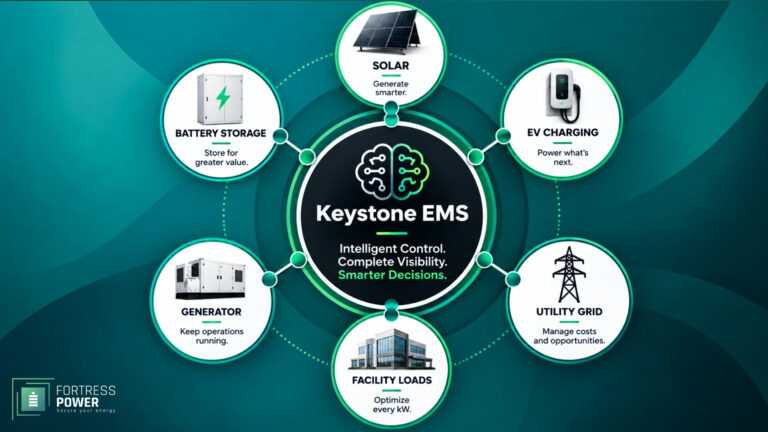
Keystone EMS provides centralized energy management across these assets, coordinating PV, battery storage, EV chargers, generators, CHP systems, and other distributed energy resources through digital communications.
Instead of looking at the battery as a standalone asset, an advanced EMS can help manage the complete energy ecosystem. This becomes particularly valuable for facilities with multiple electrical panels, feeders, or meters where site-wide visibility and control are needed.
By reducing the number of external components and simplifying configuration, installers can spend less time troubleshooting and more time delivering completed projects.
2. Utility Rates Require More Precise Energy Optimization
For many commercial facilities, reducing energy costs involves more than simply charging a battery when rates are low and discharging when rates are high.
Demand charges, time-of-use rates, seasonal rate changes, and facility load patterns can all influence when stored energy has the greatest value. With Keystone EMS, battery operation can be optimized using 15-minute utility interval data, configurable schedules, time-of-use rates, and seasonal strategies. That allows an energy storage system to respond more precisely to the site’s energy needs and utility rate structure.
For example, a business experiencing a predictable spike in demand during operating hours may use battery storage to reduce grid demand during that period. At another site, the priority may be storing solar production and discharging the battery during higher-cost utility periods. An advanced EMS provides more flexibility to build an operating strategy around the facility rather than relying on a single fixed schedule.
3. The Project Includes Existing Commercial Solar
Commercial battery storage does not always begin with a new solar installation. Many businesses already have PV and want to add energy storage later. That makes AC-coupled solar retrofits an important consideration when designing a commercial energy storage system. Both eSpire Nano Standard and Pro can support existing AC-coupled PV configurations, but Pro adds greater visibility and control.
Through Keystone EMS, eSpire Nano Pro can support communication-based PV integration and provide visibility into AC PV production. It can also coordinate AC-coupled PV during backup operation while keeping the system’s Smart Port available for another asset. For installers and EPCs, this can create more flexibility when adding battery storage to facilities with existing solar infrastructure.
4. The Facility Needs Generator or EV Charger Integration
The more equipment that needs to work together, the more important site-level energy management becomes.
With eSpire Nano Pro and Keystone EMS, the energy storage system can integrate additional distributed energy resources such as EV chargers and generators into the site’s broader energy strategy. Generator support can extend up to 1 MW, providing additional flexibility for larger C&I applications. Rather than treating backup generation, EV charging, solar, and battery storage as separate systems, an advanced EMS can coordinate how those resources interact.
For a facility expanding its EV charging infrastructure, adding backup generation, or planning for future energy needs, that flexibility can make the energy storage system more adaptable over time.
5. Energy Management Needs to Extend Beyond One System or Site
Energy management can become even more complex for businesses, EPCs, and operators responsible for multiple systems or locations.
At that point, visibility becomes just as important as control. eSpire Nano Pro is designed for applications requiring advanced energy management and multi-site asset control. Keystone EMS brings energy assets into one platform, providing the ability to monitor and manage the broader C&I energy ecosystem.
It also supports capabilities such as local data backup, utility reporting, and readiness for Virtual Power Plant (VPP) and other grid service opportunities. That creates an upgrade path for customers whose energy management requirements may become more sophisticated as their operations grow
eSpire Nano Standard vs. Pro: Which Level of Energy Management Do You Need?
An advanced EMS isn’t necessary for every commercial battery storage project.
eSpire Nano Standard is designed for more straightforward C&I applications. It includes Guardian monitoring and cloud connectivity, along with fleet management, alerts, remote visibility, peak shaving, time-of-use optimization, and solar self-consumption.
For many sites, those capabilities provide exactly what is needed. eSpire Nano Pro adds Keystone EMS for applications that require more advanced control and optimization. The Pro configuration includes the Keystone Controller and eGauge metering and expands the system’s capabilities for advanced peak shaving, TOU optimization, solar maximization, utility reporting, VPP readiness, and multi-site asset control.
The decision ultimately comes down to the complexity of the site. If the primary goal is straightforward battery monitoring and energy cost management, Standard may be the right fit. If the facility needs to coordinate multiple distributed energy resources, respond more precisely to complex utility rates, integrate existing PV, or prepare for more advanced energy strategies, Pro provides the additional intelligence to do it.
Moving From Battery Storage to Full-Site Energy Management
Commercial energy storage is becoming part of a much larger energy ecosystem. A battery may be at the center of the system, but the real opportunity comes from determining how storage works alongside solar, generators, EV charging, facility loads, and the grid. Keystone EMS turns eSpire Nano Pro into a full-site energy management solution designed to coordinate these resources and optimize how energy moves throughout a facility.
For installers and EPCs, that means the conversation can move beyond how much energy a battery can store to a bigger question: How can every energy asset at the site work together more effectively? Learn more about Fortress Power Keystone EMS and how advanced energy management can help optimize your next commercial energy storage project.